

Feeling Nihilistic? Oh, Come On! Let’s Be Optimist!

Have you ever got to the point, especially recently, of wondering what on earth is going wrong in the world? Asking yourself why can’t humans just be kinder to each other? Have you noticed that recently humans seem to be having a problem with telling right from wrong, trying to get away with things wherever they can?

My book Mastering Chaos: A Musician’s Guide seems to have come out at a significant moment. We humans do actually know how to get on with each other. As a species on this planet we have done incredible things too numerous to mention.
But more recently we seem to be doing quite a lot of bad things. Many of us seem to feel we have lost our way, that life has lost its purpose. We have so many problems to sort out that need our attention, such as unnecessary wars and the consequences of global warming.
I notice in many a feeling that life seems to be losing its meaning, a feeling that old certainties seem to have gone. They seem to have been replaced with hypocrisy and pretentiousness. I am thinking here of politicians who promise improvements but don’t deliver, and how social media algorithms wrap us up in false bubbles. There is an air of unreality.
This feeling strongly relates to something referred to as nihilism. In this article I want to talk about nihilism, what it tells us and then talk about the ideas in my book. I also want to say that there is hope. We do have solutions. There’s a few things we have to get through first.
At its core, nihilism is the philosophical belief that life lacks intrinsic meaning, purpose, or objective value. The word comes from the Latin nihil, meaning "nothing."
While it’s often painted as a dark or "edgy" outlook, nihilism is actually a broad spectrum of thought that has evolved significantly over the last two centuries.
Nihilism isn't just one single idea; it branches into different areas of human experience such as:
Existential Nihilism: This is the most common form. It suggests that the universe is vast, cold, and indifferent, and that human existence has no "grand design" or inherent point.
Moral Nihilism: This is the belief that there are no objective moral truths. "Right" and "wrong" are seen as social constructs rather than universal laws.
Epistemological Nihilism: A more radical stance claiming that true knowledge is impossible because there is no objective reality to observe.
Cosmic Nihilism: The view that human life is so insignificant in the scale of the universe that our actions, history, and eventual extinction are ultimately meaningless.
So who are the key figures in Nihilism?
Friedrich Nietzsche
Nietzsche is the name most associated with nihilism, though he wasn't exactly a fan of it. He famously declared that "God is dead," meaning that traditional religious and moral foundations were collapsing in the wake of the Enlightenment. He feared that nihilism would lead to a "will to nothingness" and social decay.
Albert Camus (Absurdism)
While not a pure nihilist, Camus explored the "Absurd"—the conflict between humans searching for meaning and the "silent," meaningless universe. His solution? Rebel against the meaninglessness by living defiantly and finding joy anyway.
So what about the more modern spin referred to as "Optimistic Nihilism"? In recent years, a more positive interpretation has gained popularity. The logic goes like this:
If the universe is huge and nothing we do matters on a cosmic scale,
Then all the pressure is off.
You can't "fail" at a life that has no pre-written script.
This perspective encourages people to create their own meaning, enjoy the moment, and be kind simply because it makes the experience of existing more pleasant.
So these are the fundamentals of nihilism. Pretty depressing isn’t it? Except that you might have seen already that there are a few clues to how we can get through to a better place.
Examining my book “Mastering Chaos: A Musician’s Guide To Navigating Complexity” through the prism of nihilism reveals a text that acknowledges the transient, "gossamer" nature of existence while providing a framework for human-constructed meaning as a defense against the void.
Nihilism often emphasises the fleeting and ultimately empty nature of physical reality. In my book I describe sound as an art form that "barely exists," a mere "pulse of air lasting only a moment or two" before it is gone. But despite this physical transience, I argue that humans have a unique capacity to "make meaning from ‘ripples in the ether’". From a nihilistic perspective, this can be seen as the ultimate existentialist act. In a universe that provides no inherent meaning, humans can use "organised sound" (language and music) to "imbue our existence with a true sense of meaning".
Our "Fear of the Void," a loss of structure, is profoundly unnerving for humans. But "truth" as such is often buried beneath "noise" and that many people take refuge in "common sense simplicities" to avoid looking at what lies beneath. However unlike a nihilist who might despair at the lack of order, the "Musician’s Way" encourages individuals to "turn and face the chaos". Chaos itself actually creates, forms and shapes the sweet spot of hope, which suggests that meaning is not something we find, but something we forge from within disorder.
A key nihilistic tenet is that there is no objective truth. Mastering Chaos partially aligns with this by stating that "meaning is context-dependent" and that our awareness of the reality of chaos is "very subjective". However the words we use to describe our reality are only "imprecise" estimations of our inner emotions. However there is in sound "musical truth can be trusted" because tonality is "honest" and creates a "conduit to the depths of human consciousness". While language might be manipulated, the "felt feeling" of music provides a grounded reality.
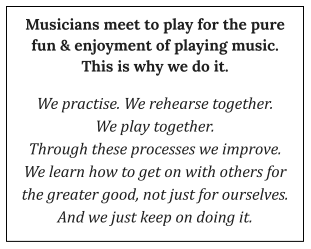
Nihilism can lead to the belief that because there is no ultimate "goal" or "win" in life, actions are pointless, but bring forward the idea that we humans actually play an "Infinite Game": Humanity’s success is based on the realisation that we play "not to win but to continue to play". In a universe without a final scoreboard, the "pure fun & enjoyment of playing" becomes its own justification. This aligns with "optimistic nihilism," where the absence of cosmic purpose grants humans the freedom to find value in human collaborative processes which grants us "Collective Wisdom".
While nihilism often focuses on the isolation of the individual in a meaningless universe, in Mastering Chaos I argue for humanity’s fundamental interconnectedness. Sound and language are tools that make the "awareness of self more bearable by facilitating connection with other human beings. By moving toward the "Grounded Space" and drawing on the "Wisdom of the Collective," humans are able to create a "unified musical tapestry" that transcends individual insignificance.
In summary, my book Mastering Chaos adopts the view that whilst the world seems chaotic, transient, and devoid of inherent structure, humanity’s "superpower" is the ability to collaboratively invent purpose, turning the "noise" of the universe into the "music" of a meaningful life.

Comments